

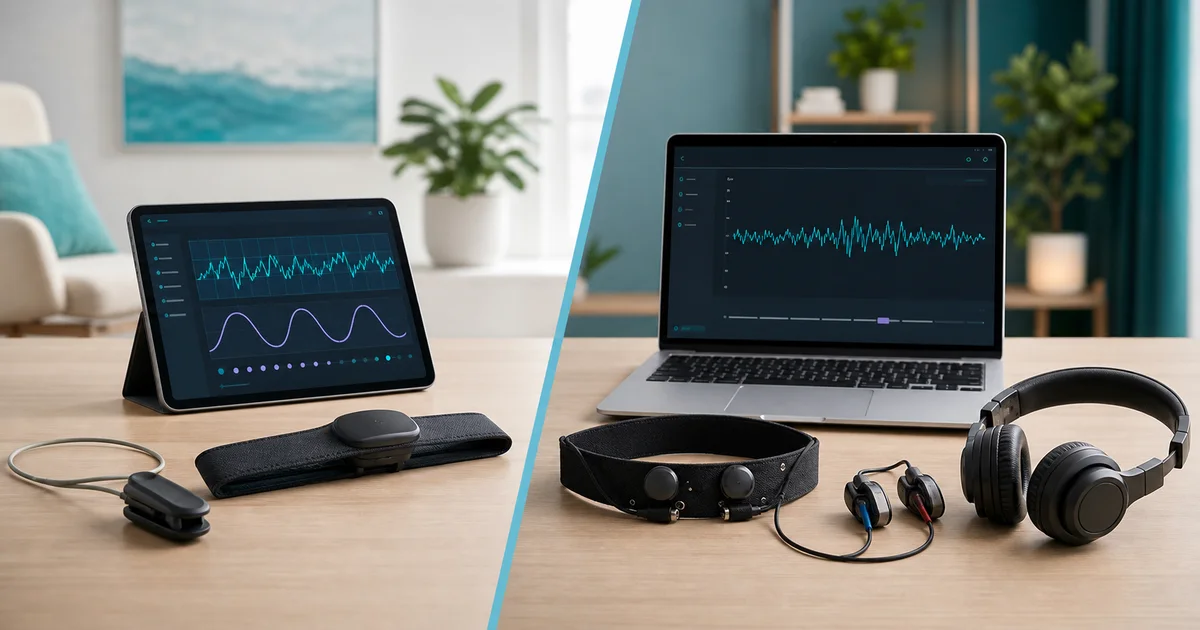
Biofeedback is the broader category; neurofeedback is one form of biofeedback that uses information about brain activity. The most useful comparison is therefore not which label sounds more advanced. It is which physiological signal a system measures, where its sensors are placed, how that information is returned to you, and what training the provider has for that specific method.
That distinction matters when you are comparing a provider, an in-office session, or equipment for home use. Two products may both use the word “feedback” while measuring different signals—or while providing completely different kinds of feedback.
The short answer: neurofeedback sits within biofeedback
The Association for Applied Psychophysiology and Biofeedback describes biofeedback as a process in which instruments measure physiological activity and rapidly return information to the user. Its examples include brain activity, heart function, breathing, muscle activity, and skin temperature.
When the measured information comes from brain activity, the process is commonly called neurofeedback, EEG biofeedback, or brain-wave training. In other words, neurofeedback is not the opposite of biofeedback. It is a more specific category within it.
| Comparison point | Biofeedback | Neurofeedback |
|---|---|---|
| Category | An umbrella term covering feedback based on one or more physiological signals. | A form of biofeedback based on information about brain activity. |
| Possible measured signals | Examples include muscle activity, heart timing, breathing, skin temperature, skin conductance, and brain activity. | Common professional descriptions focus on electrical brain activity recorded at the scalp with EEG. |
| Typical sensor location | Depends on the signal. Sensors may be placed on a finger, hand, chest, abdomen, or specific muscle area. | Sensors are commonly placed on the scalp, with additional reference or ground sensors depending on the system. |
| Feedback format | Numbers, graphs, paced displays, tones, games, or other visual, audio, or tactile cues. | Visual or audio feedback may change in response to the measured brain activity. |
| What to verify | The exact signal, sensor, device, feedback method, and provider training for that modality. | The brain signal being measured, the sensor setup, the feedback method, and the provider’s neurofeedback training. |
These are category-level examples, not a promise that every device or provider uses the same setup. A product name alone does not tell you what is being measured.
Start with the measured signal, not the device label
A practical comparison begins with one question: What does this system measure in real time?
- Surface electromyography (sEMG) measures electrical activity associated with muscles.
- Heart-rate and heart-rate-variability feedback uses information about heart timing.
- Respiratory biofeedback measures a breathing pattern or rate.
- Thermal biofeedback uses skin-temperature information.
- Electrodermal or GSR feedback measures changes in skin conductance.
- EEG neurofeedback uses electrical activity recorded at the scalp.
The Biofeedback Certification International Alliance separates its credentials along the same lines. Its modalities comparison describes general biofeedback certification as covering sEMG, thermal, GSR, respiration, and introductory HRV content, while its consumer guide lists a separate designation for neurofeedback, also called EEG biofeedback.
This is why framing biofeedback versus neurofeedback as an either-or choice can be misleading. A clearer question is: “Am I comparing EEG neurofeedback with muscle, heart, breathing, temperature, or skin-conductance feedback?”
The feedback channel is not the measured signal
It also helps to separate the input from the feedback:
- The input is the physiological signal the sensors measure.
- The system processes that signal according to its method and software.
- The feedback is what the user sees, hears, or feels in response.
For example, music may be the feedback channel while EEG is the measured input. A changing graphic could be the feedback channel while breathing or heart timing is the measured input. The same type of audio or visual display can therefore appear in very different systems.
The AAPB standards also distinguish feedback from devices that only deliver stimulation or entrainment without measuring and returning real-time physiological information. If a product uses light, sound, vibration, or another stimulus, ask whether it also measures a physiological signal and how that signal changes the experience.
What the equipment can tell you
Before comparing brands or prices, ask for the complete signal path:
- Sensors: What do they detect, and where are they placed?
- Signal processing: What hardware and software receive the sensor data?
- Feedback: Does the user see a graph, follow a display, hear changing audio, play a game, or receive another cue?
- User role: Is the user asked to practice a particular skill, follow coaching, or simply remain comfortable while the system provides feedback?
- Provider role: Who sets up the equipment, explains the process, monitors the session, and answers questions?
The International Society for Neuroregulation & Research’s practice guidelines describe a common neurofeedback arrangement: scalp sensors connect to an amplifier and computer, the system records electrical brain activity, and feedback is presented through a changing game or soundtrack. Individual systems can still differ in their hardware, software, training model, and the actions expected from the user.
How Freedom’s neurofeedback sessions fit this comparison
Freedom’s website describes its sessions as NeurOptimal® neurofeedback. Its in-office session page says sensors are placed on the scalp and ears and that the client listens to music containing the system’s feedback.
If you are looking for a different type of biofeedback, ask whether that exact modality is available before scheduling. Freedom’s published session information describes its NeurOptimal neurofeedback service; ask directly about the availability of any other biofeedback modality. If you are specifically comparing neurofeedback approaches, read Freedom’s overview of what neurofeedback training means and ask how the method described there differs from the other option you are considering.
Ten questions to ask a biofeedback or neurofeedback provider
- What physiological signal does your equipment measure? Ask for a plain-language answer rather than only a product name.
- Where will the sensors be placed? The answer should match the signal being measured.
- What will I see, hear, or do during the session? This clarifies the feedback format and your role.
- Is the device measuring real-time information, delivering stimulation, or doing both? These are different functions.
- Which biofeedback modalities do you actually provide? General biofeedback and neurofeedback are not interchangeable service menus.
- What training and credentials apply to this specific modality? BCIA uses different designations for general biofeedback and neurofeedback, and certification is not the same as a professional license.
- What is the provider’s role during the session? Ask who handles setup, observation, coaching, and technical questions.
- What information is recorded or stored? Ask whether the system retains session or account data and how it is handled.
- What does the quoted price include? Confirm the session, equipment, supplies, software, support, and any ongoing costs that apply.
- What are the limits of the service? A provider should be able to explain what is being offered without making the equipment sound like a substitute for medical care.
If your comparison includes a full system, consumers who want to purchase a NeurOptimal system must visit the NeurOptimal website directly for current equipment, license, support, and purchase terms. Request current written details rather than relying on an older article or saved price.
A simple way to compare two options
Create one row for each option and fill in these eight fields: measured signal, sensor type and location, feedback format, user role, provider role, session setting, total current cost, and support. If a provider or seller cannot clearly identify the measured signal and feedback loop, you do not yet have enough information for a meaningful comparison.
Once those facts are visible side by side, the terminology becomes easier. You are no longer comparing two broad labels. You are comparing two specific measurement-and-feedback systems and the services surrounding them.
Frequently asked questions
Is neurofeedback a type of biofeedback?
Yes. Professional organizations describe neurofeedback as biofeedback based on information about brain activity. EEG biofeedback is another common name for neurofeedback.
Does every biofeedback device measure brain activity?
No. Biofeedback can be based on several physiological signals, including muscle activity, heart timing, breathing, skin temperature, skin conductance, and brain activity. Ask which signal a specific device measures.
Does every device that uses lights, sound, or vibration provide biofeedback?
Not necessarily. The defining question is whether the device measures physiological information and returns feedback based on that information. A device that only delivers a stimulus belongs in a different comparison category.
How should I compare provider credentials?
Ask about training for the exact method being offered, any relevant professional license, the provider’s scope of practice, and whether supervision applies. BCIA distinguishes its general biofeedback and neurofeedback credentials, and its consumer directory explains those designations.
General wellness note: This article explains equipment categories and practical provider questions. It does not compare clinical effectiveness and is not medical advice. Questions about a health condition or medical care should be directed to a qualified healthcare professional.
Sources and further reading
- Association for Applied Psychophysiology and Biofeedback: Standards for Performing Biofeedback
- International Society for Neuroregulation & Research: Guidelines for Practice
- Biofeedback Certification International Alliance: Biofeedback and Neurofeedback Modalities Comparison
- Biofeedback Certification International Alliance: Consumer Guide and Practitioner Designations
- Freedom Neurofeedback: What Is Neurofeedback Training?
- Freedom Neurofeedback: Neurofeedback Sessions
